
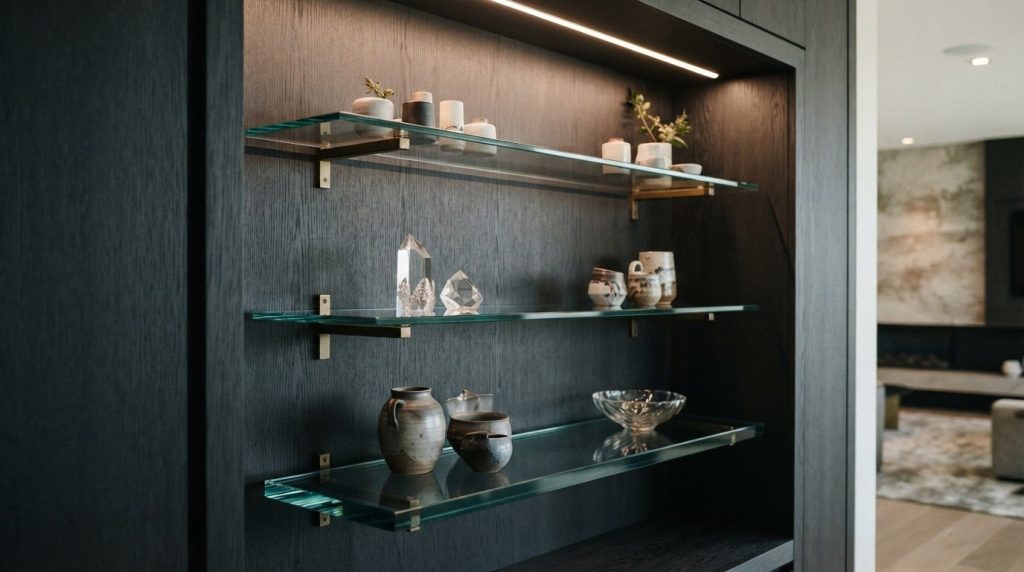
The right glass shelf thickness depends on more than just the thickness of the glass. The shelf’s dimensions, unsupported span, support system, glass type, and the weight it needs to carry all affect the appropriate specification.
For many residential applications, 1/4-inch glass is a common choice, while 3/8-inch and 1/2-inch glass may be appropriate for longer spans, heavier loads, or projects where a more substantial architectural appearance is desired.
However, there is no universal thickness or weight rating that applies to every glass shelf. A properly designed shelf needs to be evaluated as a complete installation.
In this guide, we’ll explain the differences between 1/4-inch, 3/8-inch, and 1/2-inch glass, how span and loading affect glass shelf design, the differences between tempered and annealed glass, and how glass thickness influences the appearance of your finished project.
Key Takeaways
- 1/4-inch glass is a common choice for many residential glass shelving and cabinet applications.
- 3/8-inch and 1/2-inch glass can provide greater stiffness and a more substantial architectural appearance for larger or heavier-duty installations.
- Glass thickness alone does not determine the safe weight capacity of a shelf. Span, shelf dimensions, support locations, glass type, hardware, and load distribution must also be considered.
- Tempered glass provides substantially greater surface strength and thermal resistance than annealed glass of the same thickness and is often preferred for functional shelving.
- Low-iron glass can reduce the noticeable green edge associated with standard clear glass, particularly in thicker shelves.
- Edge treatments such as flat polish, pencil polish, and beveling can significantly change the appearance of a glass shelf.
- For custom installations, the appropriate glass specification should be determined based on the complete application rather than thickness alone.
Table of Contents
- Standard Glass Shelf Thicknesses and Their Applications
- How Glass Shelf Thickness Affects Span and Deflection
- Understanding Glass Shelf Weight and Loading
- Tempered vs. Annealed Glass for Shelves
- Glass Shelves vs. Decorative Cabinet Glass
- How Glass Thickness Affects the Appearance of a Shelf
- Clear Glass vs. Low-Iron Glass
- Choosing the Right Edge Finish
- Glass Shelves with Integrated LED Lighting
- Designing Custom Glass Shelves with Casa Loma Art Glass
- Frequently Asked Questions
Standard Glass Shelf Thicknesses and Their Applications
Glass shelves are available in a variety of thicknesses, but the most appropriate option depends on how the shelf will be used.
A small decorative shelf carrying lightweight objects has very different requirements from a long floating shelf supporting books, glassware, or other heavy items.
Here are three common glass thicknesses and where they may be appropriate:
| Glass Thickness | Common Applications | Appearance | Key Considerations |
|---|---|---|---|
| 1/4 inch | Residential shelving, cabinet applications, display shelving | Light and versatile | Common choice for many shorter spans |
| 3/8 inch | Longer or heavier-duty shelving, bars, displays | More substantial | Provides greater stiffness and visual weight |
| 1/2 inch | Architectural and floating shelves, luxury interiors | Bold and substantial | Heavier and requires an appropriately designed support system |
Important: Glass thickness alone does not determine the safe load capacity or maximum span of a shelf. The shelf dimensions, support configuration, glass type, loading conditions, and allowable deflection all need to be considered.
1/4-Inch Glass
1/4-inch glass is one of the most commonly used thicknesses for residential glass applications.
It provides a good balance between visual lightness and durability and is frequently used for:
- Residential glass shelves
- Cabinet applications
- Display shelving
- Bathroom shelving
- Decorative shelving
- Glass inserts and other architectural applications
For many shorter shelf spans and appropriately designed support systems, 1/4-inch glass can provide an attractive and practical solution.
However, it should not automatically be considered suitable for every shelf simply because it is a common thickness.
3/8-Inch Glass
3/8-inch glass provides a noticeably more substantial appearance than 1/4-inch glass.
It can be appropriate when:
- The shelf has a longer unsupported span
- Heavier objects will be displayed
- Greater stiffness is desired
- The design calls for a more substantial architectural appearance
- The shelf is part of a high-end bar, display, or architectural installation
The additional thickness also creates a more noticeable glass edge, which can become an important part of the design.
1/2-Inch Glass
1/2-inch glass creates a bold architectural appearance.
It is frequently considered for:
- Large floating shelves
- High-end bar shelving
- Architectural display systems
- Heavy-duty decorative shelving
- Luxury residential interiors
- Commercial display installations
The visual difference between 1/4-inch and 1/2-inch glass is significant. A 1/2-inch shelf has a much more substantial edge and can become an intentional architectural element rather than simply a functional surface.
Because 1/2-inch glass is considerably heavier, the support system must be designed to accommodate both the weight of the glass itself and the objects placed on it.
How Glass Shelf Thickness Affects Span and Deflection
One of the most important factors in determining glass shelf thickness is the unsupported span.
The span is the distance between the points supporting the glass.
For example, if a shelf is supported at both ends and there is 30 inches of open space between those supports, the unsupported span is 30 inches.
As the span increases, the glass becomes more susceptible to deflection, which is the technical term for bending or sagging under load.
A short shelf may remain relatively rigid with 1/4-inch glass, while a much longer shelf made from the same thickness may show noticeable deflection when carrying the same type of load.
Why Thickness Matters
Increasing glass thickness can substantially increase stiffness. However, choosing the thickness based solely on the span is not enough.
The design also needs to consider:
- Shelf width and depth
- Unsupported span
- Glass thickness
- Glass type
- Support locations
- Type of brackets or channels
- Method of attachment
- Uniform vs. concentrated loading
- Expected weight
- Allowable deflection
This is why there is no universal “24-inch rule” that applies to every glass shelf.
A 24-inch shelf carrying lightweight decorative objects is very different from a 24-inch shelf supporting a concentrated load of heavy glass bottles.
Understanding Glass Shelf Weight and Loading
When determining how thick a glass shelf should be, it’s important to understand what will actually be placed on the shelf.
There are two basic types of loading to consider.
Uniform Load
A uniform load is distributed across a substantial portion of the shelf.
For example, several relatively lightweight decorative objects spread across the entire surface create a more distributed load.
Point Load
A point load is concentrated in one particular area.
For example, placing a heavy sculpture or a large piece of equipment in the center of a shelf creates a concentrated load.
Point loads can have a significantly different effect on a shelf than the same total weight distributed across the entire surface.
Don’t Forget the Weight of the Glass
The shelf itself also has weight.
As glass becomes thicker, it becomes heavier. A 1/2-inch shelf therefore places substantially more demand on the brackets, wall anchors, cabinet supports, or other hardware than a 1/4-inch shelf of the same dimensions.
This is particularly important when designing floating shelves.
Tempered vs. Annealed Glass for Shelves
Glass shelf design involves more than choosing the correct thickness. The type of glass is also important.
The two basic categories you’ll encounter are annealed glass and tempered glass.
What Is Annealed Glass?
Annealed glass is glass that has not undergone the thermal tempering process.
It can be appropriate for many decorative applications, particularly when the glass is fully contained within a frame or otherwise protected.
However, when glass is being used as functional shelving, particularly where the glass is exposed to impact, tempered glass is often preferred for its safety characteristics and greater resistance to thermal and mechanical stresses.
What Is Tempered Glass?
Fully tempered glass undergoes a controlled heating and rapid cooling process that creates compressive stress at the glass surfaces.
This gives tempered glass substantially greater surface strength and thermal resistance than annealed glass of the same thickness.
Another important safety characteristic is its break pattern.
When fully tempered glass breaks, it generally fractures into many small pieces rather than the large sharp shards typically associated with broken annealed glass.
However, tempering does not make a shelf immune to breakage, and it does not eliminate the need to properly size the glass and support system.
ASTM C1048 establishes requirements for heat-strengthened and fully tempered flat glass. Shelf design itself also requires consideration of the support system, dimensions, anticipated loads, and allowable deflection.
Tempered Glass Must Be Fabricated Before Tempering
One important consideration when ordering tempered glass is that the glass must be fully fabricated before it enters the tempering furnace.
That means operations such as:
- Cutting
- Drilling
- Notching
- Edgework
- Holes
- Cutouts
must be completed before tempering.
Once glass has been tempered, it cannot normally be cut or drilled without causing it to break.
This makes accurate measurements and careful planning particularly important for custom glass shelves.
When Is Tempered Glass Appropriate?
Tempered glass is frequently selected for functional shelving because of its increased strength and safety characteristics.
It can be particularly appropriate for applications where the glass is:
- Exposed to potential impact
- Used in a high-traffic area
- Near sources of thermal stress
- Used as functional shelving
- Installed in a location where safety glazing requirements apply
Whether safety glazing is required depends on the specific application, location, and applicable building codes.
For that reason, the glass should be specified based on the actual installation rather than assuming that every shelf has identical requirements.
Glass Shelves vs. Decorative Cabinet Glass
One important distinction is often overlooked: glass used in a cabinet door is not performing the same job as glass used as a shelf.
A cabinet-door insert is generally retained within a door frame. The frame supports the perimeter of the glass and the glass is primarily serving a decorative or visual function.
A shelf, on the other hand, must support:
- Its own weight
- The weight of the objects placed on it
- The forces created by the support system
- Potential impact or concentrated loading
Because of this, you should not automatically use the same glass thickness for a cabinet-door insert and a functional glass shelf.
For custom cabinet doors, the appropriate glass specification depends on the door construction, opening dimensions, retention method, and intended application.
For functional shelving, span, support, and loading become much more important considerations.
This distinction is particularly important when choosing between decorative cabinet glass and functional glass shelving.
How Glass Thickness Affects the Appearance of a Shelf
Glass thickness isn’t purely a structural decision. It also changes the appearance of the finished project.
A 1/4-inch shelf has a relatively light visual presence.
A 3/8-inch shelf has a more substantial edge.
A 1/2-inch shelf can become an intentional architectural feature.
This makes thickness an important part of the design process.
For minimalist interiors, thinner glass can allow the objects themselves to become the focal point.
For luxury bars, libraries, display walls, and architectural installations, thicker glass can create a stronger visual presence.
Clear Glass vs. Low-Iron Glass
One of the most noticeable aesthetic differences between standard clear glass and low-iron glass becomes apparent when looking directly at the edge.
Standard clear glass contains naturally occurring iron compounds that can give the glass a subtle green tint.
The effect is usually difficult to notice when looking through a thin piece of glass.
However, the edge becomes increasingly visible as the glass gets thicker.
This can be especially noticeable with:
- White cabinetry
- White countertops
- Light-colored marble
- Pale tile
- Contemporary kitchens
- Minimalist interiors
What Is Low-Iron Glass?
Low-iron glass is manufactured with reduced iron content, producing a much clearer appearance.
The edge has considerably less green coloration, allowing the glass to appear cleaner and more neutral.
For thick glass shelves where the edge is highly visible, low-iron or ultra-clear glass can be an excellent design choice.
It can also help preserve the appearance of colors viewed through the glass.
Choosing the Right Edge Finish
The edge of a glass shelf is not simply a technical detail. It can become an important part of the overall design.
Flat-Polished Edge
A flat-polished edge provides a clean, crisp appearance and is particularly well suited to contemporary and minimalist interiors.
It can also produce a subtle reflective line when light strikes the edge.
Pencil-Polished Edge
A pencil-polished edge has a softly rounded profile.
It provides a smoother tactile surface and can work particularly well in applications where people will frequently handle or come into contact with the shelf.
Beveled Edge
A beveled edge creates an angled decorative surface along the perimeter of the glass.
The angled surface catches and refracts light, creating a more decorative appearance.
Beveled edges can be especially effective in traditional, transitional, formal, and luxury interiors.
The support hardware should be selected carefully when using a beveled edge because the perimeter geometry differs from a standard flat edge.
Glass Shelves with Integrated LED Lighting
Glass shelves can also be incorporated into illuminated display systems.
When LED lighting is introduced through or near the edge of a glass shelf, the polished edge can help create a distinctive illuminated effect.
This approach can be particularly effective for:
- Home bars
- Liquor displays
- Display cabinets
- Retail environments
- Luxury kitchens
- Entertainment areas
- Architectural feature walls
The final result depends on the glass, edge treatment, LED configuration, support system, and lighting placement.
For custom illuminated shelving, these elements should be considered together rather than treating the glass as an isolated component.
Designing Custom Glass Shelves with Casa Loma Art Glass
Choosing the right glass shelf thickness starts with understanding how the shelf will actually be used.
At Casa Loma Art Glass, we fabricate custom glass shelves for residential and commercial applications, including kitchens, bars, display cabinets, bathrooms, living spaces, and architectural interiors.
Our process considers the complete project rather than simply selecting a thickness from a chart.
Depending on the application, we can work with different glass thicknesses, glass types, edge finishes, and custom dimensions to create a finished shelf that fits both the functional requirements and the design intent of the project.
Custom Glass Shelf Options
Depending on your project, custom glass shelves can be fabricated with:
- 1/4-inch glass
- 3/8-inch glass
- 1/2-inch glass
- Clear glass
- Low-iron ultra-clear glass
- Tempered safety glass
- Polished edges
- Beveled edges
- Custom shapes
- Holes and cutouts
- Specialty decorative glass
For architectural and luxury interiors, we can also help integrate decorative glass elements into a larger design.
What We Need to Know About Your Project
If you’re requesting a custom glass shelf, providing a few basic details can help determine the appropriate glass specification.
Ideally, provide:
- Shelf width
- Shelf depth
- Unsupported span
- Number and location of supports
- Type of brackets or mounting system
- Approximate weight of the items being displayed
- Whether the load will be distributed or concentrated
- Desired glass appearance
- Preferred edge finish
- Whether the shelf will be exposed to heat or impact
Photos or drawings of the installation can also be extremely helpful.
Custom Glass Shelves by Casa Loma Art Glass
Casa Loma Art Glass specializes in custom glass fabrication for residential and architectural applications.
In addition to standard glass shelves, our studio works with decorative and architectural glass, including custom cabinet glass inserts, stained glass, decorative glass panels, door glass, and specialty glass installations.
Whether you need a simple clear glass shelf or a more distinctive architectural feature, we can help you evaluate the glass thickness, finish, appearance, and fabrication requirements for your project.
Request a Custom Glass Shelf Quote
Frequently Asked Questions
How thick should a glass shelf be?
The appropriate thickness depends on the shelf dimensions, unsupported span, support configuration, glass type, and anticipated load. 1/4-inch glass is common for many residential applications, while 3/8-inch and 1/2-inch glass may be appropriate for longer spans, heavier loads, or projects requiring a more substantial appearance.
There is no single thickness that is appropriate for every installation.
How much weight can a 1/4-inch glass shelf hold?
There is no universal weight rating for a 1/4-inch glass shelf.
Its capacity depends on the shelf’s width and depth, unsupported span, support locations, glass type, hardware, and how the load is distributed.
A short shelf carrying lightweight decorative objects presents a very different loading condition from a long shelf carrying heavy objects concentrated near the center.
For custom installations, the complete shelf and support system should be evaluated rather than relying on thickness alone.
Is 3/8-inch glass too heavy for a kitchen cabinet?
3/8-inch glass can be appropriate for certain cabinet applications, but the cabinet construction and hardware need to be considered.
The weight of thicker glass can be significantly greater than thinner glass, so the cabinet door, shelf supports, hinges, and retention system should be capable of handling the additional weight.
For decorative cabinet-door inserts, the appropriate thickness should be determined based on the specific door construction and glass application.
Do I always need tempered glass for shelves?
Not necessarily.
Tempered glass is often preferred for functional shelving because it provides substantially greater surface strength and thermal resistance than annealed glass of the same thickness and has a safer break pattern.
However, whether tempered glass is required depends on the specific application, location, applicable safety requirements, and building codes.
What is the maximum span for a glass shelf without a middle support?
There is no single maximum span that applies to every glass shelf.
The appropriate span depends on:
- Glass thickness
- Shelf dimensions
- Glass type
- Support configuration
- Anticipated load
- Load distribution
- Allowable deflection
As the unsupported span increases, thicker glass or additional support may be necessary.
If you’re planning a long floating shelf, the complete installation should be evaluated before selecting the glass.
Can I use 1/2-inch glass for a floating shelf?
Yes. 1/2-inch glass can be used for floating and architectural shelves when the support system is appropriately designed.
Because 1/2-inch glass is significantly heavier than thinner glass, the brackets, channels, wall anchors, and mounting structure need to be capable of supporting both the glass itself and the intended load.
The result can be particularly striking when a substantial polished glass edge is part of the design.
What happens if a glass shelf is too thin for its span?
A shelf that is undersized for its span and loading conditions can experience excessive deflection, which appears as bending or sagging.
Excessive deflection can affect the appearance and performance of the installation and may indicate that the glass thickness, support system, span, or loading needs to be reconsidered.
This is why glass shelf design should consider the entire installation rather than thickness alone.
Does a beveled edge make a glass shelf weaker?
A properly fabricated beveled edge does not automatically make a glass shelf unsuitable for its intended application.
However, the bevel changes the geometry of the glass at the perimeter and can affect how the shelf interacts with brackets, clips, channels, or other support hardware.
The support system should therefore be designed or selected to work with the specific edge treatment.
Is low-iron glass worth it for thick glass shelves?
Low-iron glass can be an excellent choice when you want a very clear, neutral appearance.
The green tint associated with standard clear glass becomes more noticeable at the edge as glass thickness increases.
For 3/8-inch and 1/2-inch shelves, particularly in white or contemporary interiors, low-iron glass can provide a cleaner-looking edge and more accurate color appearance.
What is the best glass for a luxury bar shelf?
The appropriate glass depends on the dimensions, support system, loading, and design goals.
For a high-end bar, options such as 3/8-inch or 1/2-inch glass, tempered glass, low-iron glass, and polished edges can create a substantial architectural appearance.
Low-iron glass is particularly attractive when the green edge of standard clear glass would contrast with the cabinetry or interior design.
Ready to Buy Custom Glass Shelves?
If you already know the size, thickness, and style of glass you need, you can shop our selection of custom glass shelves directly from Casa Loma Art Glass. Choose from different glass thicknesses and options for your project.
Ready to Buy Custom Glass Shelves?
If you already know the size, thickness, and style of glass you need, you can shop our selection of custom glass shelves directly from Casa Loma Art Glass. Choose from different glass thicknesses and options for your project.
Final Thoughts: Choosing the Right Glass Shelf Thickness
Choosing the right glass shelf thickness isn’t simply a matter of picking the thickest glass available.
The best specification balances span, loading, support, safety, appearance, and budget.
For many residential applications, 1/4-inch glass provides a clean and relatively lightweight appearance. When a project calls for greater stiffness, a longer span, heavier loading, or a more substantial architectural look, 3/8-inch or 1/2-inch glass may be appropriate.
The type of glass matters as well. Tempered glass can provide important safety and performance advantages, while low-iron glass can create a noticeably cleaner appearance in thicker shelves. Edge treatments such as polished and beveled edges provide another opportunity to make the glass part of the overall design.
If you’re unsure how thick your glass shelf should be, don’t rely on a thickness chart alone. Consider the complete installation—including the dimensions, span, supports, anticipated load, glass type, and desired appearance.
Ready to design a custom glass shelf? Contact Casa Loma Art Glass to discuss your dimensions, application, and design requirements.