
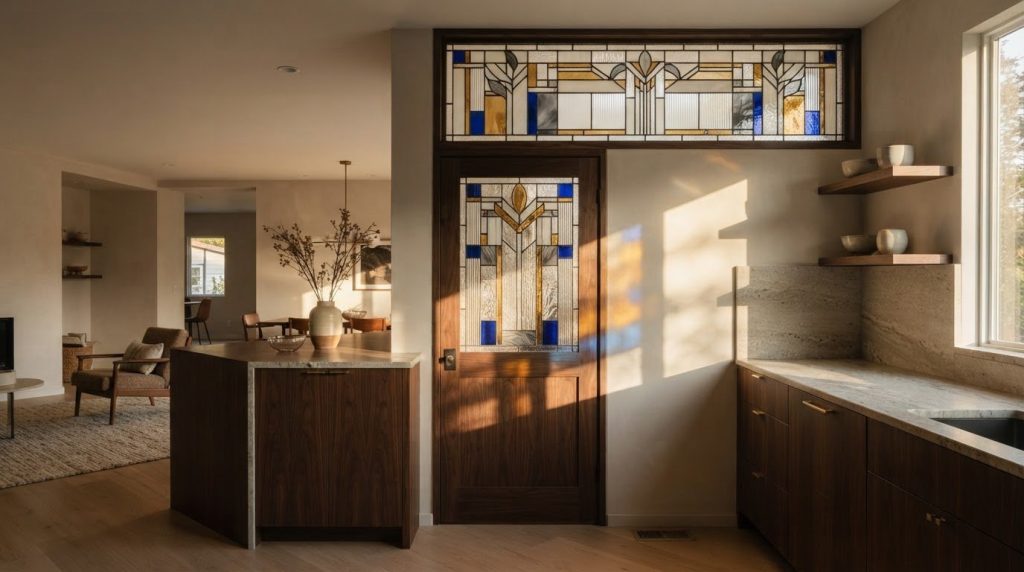
Most homeowners think of stained glass as something reserved for historic homes, churches, or antique interiors. But modern architectural stained glass design has evolved far beyond traditional applications. Today, custom art glass can function as both architectural detail and a dynamic source of light, transforming how a room looks and feels throughout the day.
As natural daylight passes through handcrafted glass, colors, textures, and patterns can create changing reflections and shadows across walls, floors, cabinetry, and other surfaces. The result is a living design element that can add personality, privacy, and visual interest to an otherwise ordinary space.
If you love the idea of custom art glass but aren’t sure how stained glass can work with a contemporary, transitional, traditional, or modern interior, the possibilities may be broader than you think.
In this guide, we’ll explore how architectural stained glass works with natural light, popular design styles, glass textures and materials, applications throughout the home, and what to expect when working with a professional art glass studio.
Key Takeaways
- Understand how natural daylight and window orientation can affect the appearance of stained and textured glass.
- Explore how traditional stained glass styles can be adapted for contemporary and transitional interiors.
- Learn the differences between transparent, translucent, textured, and opalescent glass and how each affects privacy and light.
- Discover applications for custom art glass beyond traditional windows, including cabinet glass inserts, door glass, transoms, decorative panels, and skylights.
- Learn how the custom design and fabrication process works, from the initial concept through fabrication and installation.
Table of Contents
- Foundations of Architectural Stained Glass Design
- How Natural Light Changes Stained Glass Throughout the Day
- Balancing Beauty, Light, and Privacy
- Popular Stained Glass Design Styles
- Choosing Glass Types and Textures
- Lead Came, Copper Foil, and Metal Details
- Where to Incorporate Custom Stained Glass
- Kitchen Cabinet Glass Inserts
- Doors, Sidelights, and Transom Windows
- Stained Glass Skylights and Decorative Ceiling Features
- The Custom Stained Glass Design Process
- Frequently Asked Questions
Foundations of Architectural Stained Glass Design
Architectural stained glass is much more than a decorative panel. When designed for a specific architectural opening, it becomes part of the overall composition of the room.
The size and shape of the opening, surrounding millwork, available natural light, privacy requirements, interior finishes, and the home’s architectural style all influence the design.
A successful custom panel should feel intentional rather than simply added to a space.
Casa Loma Art Glass provides custom stained glass design services that allow homeowners, designers, builders, and architects to develop artwork specifically for their project.
Every project can be approached differently. Some homeowners begin with a particular pattern or historical reference. Others start with the colors, textures, or overall feeling they want the glass to create.
The design process can then translate those ideas into a custom panel scaled specifically to the architectural opening.
How Natural Light Changes Stained Glass Throughout the Day
One of the most compelling characteristics of architectural stained glass is that it changes as the available light changes.
A panel that looks one way in the morning may appear completely different in the afternoon. Weather, season, window orientation, interior lighting, and surrounding surfaces can all influence the appearance of the glass.
Morning and Afternoon Light
East-facing windows typically receive stronger morning light, while west-facing openings can receive intense afternoon and evening sunlight.
South-facing openings may receive substantial direct sunlight throughout the day, while north-facing windows often receive softer and more consistent indirect light.
These differences can influence the choice of glass.
For example, transparent colored glass can allow sunlight to project color into a room, while textured and translucent glass can diffuse the light and soften the overall effect.
Evening Illumination
The experience doesn’t necessarily end when the sun goes down.
Interior lighting can illuminate a stained glass panel from behind, allowing the colors, textures, and pattern to remain visible after dark.
This is particularly effective in entryways, kitchen cabinetry, interior doors, and decorative architectural features.
Balancing Beauty, Light, and Privacy
Stained glass and decorative glass can provide privacy without making a room feel dark or closed off.
This is one reason textured and translucent glass are so popular for bathrooms, entryways, sidelights, interior doors, and street-facing windows.
Different glass textures can distort or obscure the view while still allowing natural light to enter.
For example, textured glass can soften silhouettes while maintaining a relatively bright environment. More opaque or opalescent glass can provide greater visual obstruction where privacy is especially important.
Casa Loma’s decorative glass panels can be designed for applications where both aesthetics and privacy are important.
For homeowners looking specifically for privacy windows, custom stained glass can also create a much more decorative alternative to blinds, curtains, or standard frosted glass.
Popular Stained Glass Design Styles
Custom stained glass doesn’t have to look old-fashioned.
One of the advantages of working with a custom art glass studio is the ability to adapt traditional techniques and design influences to the architecture of a contemporary home.
Prairie and Craftsman-Inspired Geometry
Prairie and Craftsman-inspired designs often feature strong geometric lines, rectangular divisions, symmetrical compositions, and subtle earth tones.
These characteristics work particularly well with wood cabinetry, natural materials, traditional millwork, and homes influenced by Arts and Crafts architecture.
Geometric stained glass can also be simplified for a more contemporary appearance by reducing the number of colors and emphasizing line, proportion, and texture.
Art Nouveau and Floral Designs
Art Nouveau and traditional floral designs use flowing curves, botanical motifs, organic shapes, and rich colors.
These styles can be particularly effective in entryways, transoms, formal living spaces, and homes with traditional or historic architectural details.
Decorative glass doesn’t necessarily have to reproduce a historical pattern exactly. A floral design can be simplified, recolored, or redesigned to coordinate with the surrounding interior.
Contemporary Geometric and Abstract Art Glass
Modern stained glass can be minimalist, architectural, and highly sophisticated.
Contemporary designs often use:
- Geometric shapes
- Asymmetrical compositions
- Minimal color palettes
- Clear and textured glass
- Strong or subtle metal lines
- Large areas of negative space
This approach allows stained glass to complement contemporary and transitional interiors without overwhelming the surrounding architecture.
For examples of different styles and applications, visit the Casa Loma Art Glass Gallery.
Choosing Glass Types and Textures
The glass itself plays a major role in the appearance of a finished panel.
Two panels using the same basic design can look dramatically different depending on whether the glass is clear, textured, translucent, opalescent, colored, beveled, or a combination of several types.
Transparent and Translucent Glass
Transparent glass allows significant light to pass through and can create colorful reflections and projections when used with colored glass.
Translucent glass allows light through while diffusing it, creating a softer appearance and often providing greater privacy.
Combining transparent and translucent glass can create depth within a single design.
Textured Glass
Texture changes both the visual appearance and the way light moves through a panel.
Popular textures include:
- Seeded glass – Features small bubbles and variations that create visual interest and scatter light.
- Reeded or fluted glass – Provides strong linear texture and can distort the view behind the glass.
- Rippled or waterglass – Creates fluid visual movement and can soften silhouettes.
- Flemish glass – Provides an irregular, decorative texture that can enhance privacy.
- Baroque or swirled glass – Creates a more dramatic and artistic appearance.
Casa Loma offers a wide range of specialty glass textures and decorative glass options that can be combined to create a custom appearance.
Combining Different Glasses
Some of the most interesting custom panels combine several types of glass.
A designer might use a clear textured glass for the background, colored glass for selected areas, and beveled or faceted elements as accents.
The combination creates visual depth while allowing the overall design to remain balanced.
Lead Came, Copper Foil, and Metal Details
The method used to construct a stained glass panel also influences its appearance.
Traditional lead came uses metal channels to join individual pieces of glass. The resulting lines become part of the visual design and can be particularly effective in geometric and traditional patterns.
Copper foil construction provides another approach. Casa Loma Art Glass uses the traditional copper foil technique for its handcrafted art glass. Individual pieces are cut, shaped, wrapped in copper foil, and soldered together to create the finished panel.
The Casa Loma FAQ provides additional information about the studio’s fabrication process and materials.
Metal finish is another design consideration. Depending on the application, the metal can provide either a subtle framework or a stronger graphic element.
For cabinet glass, for example, the metal finish can be selected to complement existing cabinet hardware and other finishes in the kitchen.
Where to Incorporate Custom Stained Glass
Custom art glass can be incorporated into far more than traditional exterior windows.
Some of the most popular residential applications include:
- Kitchen cabinet glass inserts
- Bathroom cabinetry
- Interior doors
- Exterior doors
- Sidelights
- Transom windows
- Privacy windows
- Stained glass windows
- Decorative wall panels
- Room dividers
- Skylights
- Ceiling features
Casa Loma’s decorative glass panels are designed for a variety of residential and commercial applications.
Kitchen Cabinet Glass Inserts
One of the easiest ways to introduce decorative glass into a home is through cabinetry.
Replacing selected solid cabinet door panels with decorative glass can make a kitchen feel more open while creating an opportunity to display dishes, glassware, or decorative objects.
It can also provide partial concealment when you don’t want cabinet contents completely visible.
Decorative Glass for Kitchens
Popular options include:
- Seeded glass
- Reeded glass
- Fluted glass
- Baroque glass
- Rippled glass
- Textured glass
- Beveled glass
- Custom stained glass
Lighting inside the cabinets can make the glass even more visually effective, particularly in the evening.
Casa Loma offers a dedicated selection of kitchen cabinet glass inserts and cabinet door glass, including both standard designs and custom options.
For homeowners looking for more design inspiration, the replacement cabinet glass collection includes a variety of patterns and styles.
Custom Cabinet Glass
For a kitchen with a specific color palette or architectural style, a completely custom design can be created rather than selecting a standard pattern.
This is particularly useful for high-end kitchens, custom cabinetry, historic renovations, and projects where the glass needs to coordinate with specific hardware, countertops, lighting, or architectural details.
Doors, Sidelights, and Transom Windows
Entry doors are another natural location for decorative glass.
A custom glass insert can create a focal point at the entrance while also addressing privacy and natural light.
Combining the glass in the door with matching sidelights or a transom above the door can create a unified architectural composition.
Casa Loma creates custom stained glass door inserts in a variety of traditional, transitional, and contemporary styles.
Transom Windows
Transoms can be particularly effective because they introduce decorative glass into an architectural area that might otherwise be overlooked.
A custom transom can allow light to pass between rooms, add visual character above a door, or provide privacy without closing off the space.
For additional ideas, see Casa Loma’s guide to designing and incorporating transom windows.
Because doors and exterior openings can have specific safety and performance requirements, the appropriate glazing construction should be determined based on the location and project requirements.
Casa Loma also offers professional art glass installation services in South Florida and the New York Metro area.
Stained Glass Skylights and Decorative Ceiling Features
Skylights offer one of the most dramatic opportunities for architectural stained glass.
Because the glass is positioned above the viewer, sunlight can illuminate the artwork throughout the day, turning the ceiling into a major architectural feature.
Custom stained glass skylights can be used in:
- Entry foyers
- Staircases
- Bathrooms
- Dining rooms
- Living rooms
- Hallways
- Double-height spaces
- Commercial interiors
Casa Loma specializes in custom stained glass skylights and ceiling features.
For larger architectural applications, the design and structural requirements of the opening should be considered early in the project so the glass, framing, and surrounding construction can work together.
The Custom Stained Glass Design Process
Commissioning a custom stained glass panel doesn’t have to be intimidating.
The process is collaborative, and a good studio should help translate your ideas into a design that works with the architecture.
Step 1: Share Your Vision and Project Details
Start by providing:
- Photos of the space
- Measurements of the opening
- Cabinet or door drawings, when available
- Interior design inspiration
- Preferred colors
- Examples of glass styles you like
- Information about the desired privacy level
- Your approximate project timeline
The more information you provide, the easier it becomes for the designer to understand your goals.
Casa Loma’s custom design service is specifically structured around collaboration between the client and the design team.
Step 2: Develop the Design
Once the basic direction is established, the design can be developed around the actual dimensions of the opening.
The artwork needs to be properly proportioned so that the individual pieces, lines, colors, and textures work together at the finished size.
For custom projects, the design can be adjusted until the overall composition meets the client’s expectations.
Step 3: Select the Glass
Glass selection is an important part of the process.
Colors can appear different depending on the amount and direction of available light, while textures can dramatically change transparency and privacy.
Selecting physical glass samples can therefore be extremely helpful when choosing the final combination.
Step 4: Fabrication
Once the design and materials are approved, the glass is carefully cut and assembled using the appropriate construction technique.
Casa Loma’s FAQ explains its handcrafted fabrication process, including the use of the copper foil technique and individual cutting and preparation of glass pieces.
Step 5: Installation and Delivery
Depending on the project, the finished glass may be installed by Casa Loma, a local contractor, glazier, or another qualified professional.
Casa Loma provides custom art glass installation services for applicable projects and also ships custom glass throughout the United States and Canada.
For shipped projects, the studio uses custom packaging designed to protect the finished glass during transportation.
Bring Custom Art Glass Into Your Home
Architectural stained glass can transform an ordinary architectural opening into a distinctive design feature.
Whether you’re looking for custom cabinet glass inserts, a decorative entry door, a private bathroom window, an artistic transom, or a dramatic stained glass skylight, the right combination of design, texture, color, and craftsmanship can make the glass feel like an integral part of the architecture.
At Casa Loma Art Glass, every project is approached as a custom piece of art designed around the client’s space, preferences, and goals.
Explore the Casa Loma Difference to learn more about the studio’s approach to custom art glass and craftsmanship.
Ready to discuss your project? Contact Casa Loma Art Glass or request a quote and share your measurements, photos, or design ideas.
Frequently Asked Questions
How much natural light will a stained glass window block?
The amount of light transmitted depends on the types of glass used.
Clear and transparent glass generally allows more light to pass through, while heavily textured, translucent, or opalescent glass diffuses light and provides greater privacy.
A custom design can combine different glass types to balance natural light, color, and privacy.
Can stained glass design be modern?
Absolutely.
Modern stained glass can use clean geometric patterns, asymmetrical compositions, neutral colors, clear textures, and substantial areas of negative space.
The result can complement contemporary, transitional, mid-century, and minimalist interiors without looking overly traditional.
What is the difference between leaded glass and stained glass?
The terms are often used interchangeably, although technically they can describe different construction and design approaches.
Leaded glass generally refers to pieces of glass joined with lead came, while stained glass traditionally refers to colored glass assembled into a decorative composition.
Modern architectural art glass can combine several techniques, materials, colors, and textures.
What glass is best for privacy?
There isn’t one universal choice.
Reeded, fluted, waterglass, Flemish, seeded, and other textured glasses can distort views while allowing natural light to enter.
More opaque or translucent glass can provide additional privacy where needed.
The appropriate choice depends on the location, viewing distance, amount of available light, and desired appearance.
Casa Loma also creates custom privacy stained glass windows for residential applications.
Can stained glass be used in cabinet doors?
Yes. Cabinetry is one of the most popular applications for decorative art glass.
Glass inserts can replace the center panel of a cabinet door and can be selected to provide anything from a relatively clear view of the contents to substantial visual concealment.
See Casa Loma’s cabinet glass collection for examples.
Can custom stained glass be installed in doors and windows?
Yes, although the appropriate construction depends on the location and application.
Interior doors, exterior doors, windows, sidelights, and transoms may have different safety and performance requirements.
Casa Loma can help determine an appropriate approach for a custom project and offers door glass and installation services.
How long does a custom stained glass project take?
The timeline depends on the size, complexity, materials, design process, and current production schedule.
Casa Loma’s current FAQ indicates that typical glass orders generally have an expected lead time of approximately four weeks from submission, although custom architectural projects can vary.
For a project-specific timeline, it is best to discuss the dimensions, design, and desired installation date with the studio.
How should architectural stained glass be cleaned?
Cleaning requirements depend on the materials and construction of the individual panel.
In general, use gentle cleaning methods and avoid abrasive materials or aggressive chemicals that could affect the glass, solder, came, or patina.
For questions about caring for a specific Casa Loma piece, contact the studio for recommendations appropriate to the particular glass and construction.
Ready to Create Your Custom Art Glass?
From custom kitchen cabinet glass and decorative panels to stained glass windows, doors, transoms, and skylights, Casa Loma Art Glass creates handcrafted glass designed specifically for your space.
Request a custom quote and tell us about your project.